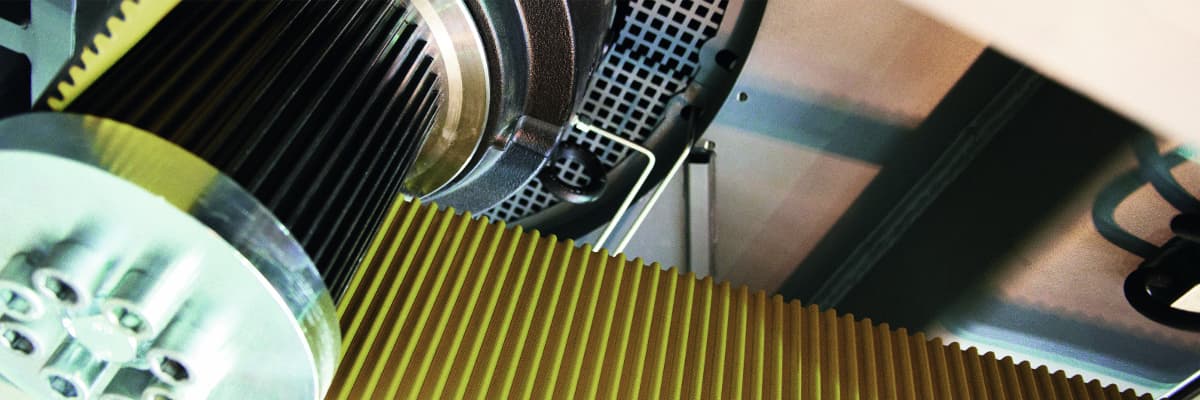
CONTI POLYFLAT for Fitness Machines
How do you choose the right flat belt for a strength training machine? Practical advice – with a worked example and technical data.

In this article, we step into the world of fitness, where CONTI POLYFLAT flat elevator belts lift the weight stacks of many types of strength training machines. Naturally, we’ll take a closer look at this less obvious use. And, as usual, we’ll keep things practical.
- From the Elevator to the Gym: CONTI POLYFLAT
- How to Choose CONTI POLYFLAT for a Strength Training Machine
- Worked Example: Replacing the Belt on a Leg Press Machine
From the Elevator to the Gym: CONTI POLYFLAT
CONTI POLYFLAT flat polyurethane belts are primarily designed for lifting applications – elevators, lifting platforms, and forklifts – yet leading manufacturers of commercial strength training machines also use them in their equipment.

Steel cables in training machines fray, break, and wear as they run over pulleys. Chains, meanwhile, are noisier and require regular lubrication, which can stain users’ clothing if carelessly applied. That is why flat polyurethane belts are far from exotic in modern strength training machines.
These belts are used, for example, in leg press, leg extension, leg curl, hip adduction and abduction, chest press, shoulder press, pec deck, lat pulldown, and seated row machines, as well as in multi-station gyms. You will find them in equipment from brands such as Matrix, Life Fitness, Panatta (the Monolith series), Nautilus, Body Masters, and Cybex.
CONTI POLYFLAT Flat Belts in the TYMA CZ Online Store
You will find them in the Lifting Belts and Ropes category, reflecting their main field of application.
The strength of the belts comes from steel or aramid tensile cords laid side by side in a single plane. The polyurethane cover protects the cords and resists abrasion, moisture, sweat, and the cleaning and disinfecting agents commonly used in fitness centers. It also provides good contact with the pulleys, allowing the belts to run smoothly and quietly without lubrication. Maintenance consists of regular visual inspections of the belt surface and attachment points.
Why Do Branded Belts Make Sense in the Gym?
For fitness equipment service providers, flat belts with tensile cords are standard replacement parts available from many suppliers. Yet they are often sold without identifying the manufacturer or providing specific technical data – sometimes it is not even clear what kind of tensile cords they contain.
Given the safety risks associated with using the machine, this is a significant problem – one that becomes critical when you are responsible for operating the equipment and for its use by others, whether professional athletes or fitness center clients. After all, a snapped belt can seriously injure the person training.
Using CONTI POLYFLAT belts in fitness machines offers several advantages:
-
Documented Specifications
ContiTech clearly specifies the permissible tensile force, breaking strength (approximately three times the permissible force), elongation (approximately 0.6% at the permissible force), dimensional tolerances, and minimum pulley diameters. Service providers can therefore select a replacement based on documented figures – and justify their choice whenever needed.
-
Selection by Load
The product range includes everything from flexible types to those with very high tensile strength. For every machine, you can choose a belt with an appropriate safety margin.
-
Consistent Quality and Controlled Composition
The belts are manufactured with consistent properties along their entire length. They also meet the strictest limits for polycyclic aromatic hydrocarbon (PAH) content under Category 1 of the AfPS GS 2014:01 PAK specification.
-
Availability and Support
We supply CONTI POLYFLAT belts by the meter, in whole-meter increments. They are cut to the required length during installation. A single stock length can thus cover repairs to several machines that use the same belt type and width.
As a Partner of Choice and authorized distributor of Continental ContiTech, we keep selected belt types in stock. Technical advice from our specialists comes as standard. All at prices comparable to common replacement belts on the market.

When Not to Use Flat Polyurethane Belts
In this article, we explain why flat belts are well suited to fitness machines. But there are exceptions.
If the machine manufacturer explicitly specifies a polyamide belt for design or safety reasons, it cannot simply be replaced with a polyurethane belt with steel or aramid tensile cords. The polyamide belt stretches noticeably before it breaks, giving timely warning that it needs replacing.
Always follow the machine manufacturer’s specifications.
Have You Been Using NSW Belts?
NSW (Norddeutsche Seekabelwerke) is permanently discontinuing production of its polyurethane belts. Continental ContiTech has signed an agreement to take over NSW’s machinery for manufacturing timing and profile belts and is relocating it to its plant in Dannenberg.
If you have been using NSW flat belts, we will be happy to discuss replacement options from the CONTI POLYFLAT range.
CONTI POLYFLAT Belts in the TYMA CZ Online Store
How to Choose CONTI POLYFLAT for a Strength Training Machine

We offer open-ended elevator belts across the full ContiTech product range. For strength training applications, the key selection criteria are their strength characteristics, dimensions, and compatibility with the machine’s pulleys.
We covered the belt design in detail in our earlier article: Innovations in CONTI POLYFLAT Flat Elevator Belt Design and Construction.
This time, we’ll highlight the essentials for selecting a belt for fitness equipment – clearly and practically:
-
Belt Strength
Depending on the belt type, the permissible tensile force per 10 mm of belt width ranges from approximately 1 kN (HF) to 10 kN (XHS II).
-
Belt Dimensions
Widths from 10 to 150 mm are available depending on the type, with thicknesses from 2.1 to 5 mm. Strength training machines most commonly use widths of 25, 30, and 40 mm. The belts are sold by the meter.
If the new belt is thinner than the original, make sure it can be securely clamped in the original clamping plates.
-
Pulley Diameter and Width
The minimum pulley diameter varies by belt type, from 50 to 200 mm. Cylindrical or crowned pulleys with side flanges are recommended.
Before replacing the belt, check the distance between the pulley flanges. According to ContiTech, it should be approximately 1.15 times the belt width. For example, a 25 mm belt requires about 28 to 29 mm between the flanges.

Worked Example: Replacing the Belt on a Leg Press Machine
A leg press from one of the leading strength training equipment manufacturers has a 175 kg weight stack.
The weight stack is lifted by a flat belt with aramid cords and a polyurethane cover, approximately 24 mm wide, with grooves on the pulley side. The belt is already worn, so we are looking for a suitable replacement. However, the machine manufacturer does not specify the strength of the OEM belt.
As a reference, we will use the NSW FL 2 flat belt with 0.9 mm steel cords, which is also used in strength training machines. At a width of 25 mm, it is 2 mm thick, with a permissible tensile force of 3.84 kN and a breaking strength of 15.2 kN. Steel-cord belts are a common replacement for belts with an aramid tension member. They are stiffer and less sensitive to moisture.
The weight stack exerts a static force of approximately 1.7 kN on the belt. When the stack starts moving, the force briefly increases. As a rough guide, we assume twice that value, i.e., approximately 3.4 kN.
CONTI POLYFLAT Candidates
Specifications for CONTI POLYFLAT belts at a width of 25 mm from the ContiTech design software
| Type / Thickness | Permissible Tensile Force | Breaking Strength | Strength ÷ Static Load* | Minimum Pulley Ø |
|---|---|---|---|---|
| F25 HP / 2.3 mm | 4,825 N | 14,475 N | 8.5× | 60 mm |
| F25 HS / 2.5 mm | 7,500 N | 22,500 N | 13× | 80 mm |
| F25 XHP / 3.0 mm | 10,000 N | 30,000 N | 18× | 100 mm |
| F25 XHP II / 3.3 mm | 13,500 N | 40,500 N | 24× | 100 mm |
* The ratio is based on breaking strength and does not include the dynamic load when the weight stack starts moving.
Assessment
-
CONTI POLYFLAT F25 HP is comparable to the NSW FL 2 belt: it has the same steel cord diameter, a higher permissible force, and a similar breaking strength, which corresponds to approximately 8.5 times the assumed static load. Its permissible force of 4.8 kN also covers the assumed doubled load when the weight stack starts moving. However, it requires a larger minimum pulley diameter than the NSW FL 2: 60 rather than 50 mm.
Even so, the HP type appears to be the most suitable candidate for further evaluation in this case.
-
CONTI POLYFLAT F25 HS offers a larger safety margin and a thickness of 2.5 mm. It can be used where the machine’s pulleys are at least 80 mm in diameter.
-
CONTI POLYFLAT F25 XHP and F25 XHP II offer a large strength margin but require pulleys at least 100 mm in diameter. Pulleys of this size are uncommon in strength training machines.
F25 HP CONTI POLYFLAT Flat Belt in the TYMA CZ Online Store

Need Advice on Selecting Flat Belts?
The worked example is for guidance only. For your specific machine, we will be happy to help you choose the right belt type and run the calculation.
We are an authorized distributor and a preferred partner of Continental ContiTech Industrial Solutions within the Partner of Choice program.